Equity is only valuable when it motivates. Yet in today’s volatile market, many employees are sitting on underwater stock options (options with a strike price above the current stock price) that have lost their retentive power. For leaders in compensation and total rewards, this creates a pressing challenge: how do you restore the value of equity and keep talent engaged when the stock price works against you?
In 2025, we saw a resurgence of companies revisiting stock option repricings as a solution, particularly in the Life Sciences sector. In this article, we'll dive into this trend, and explore a creative approach to repricing that many companies are employing to great success.
The Problem: Underwater Stock Options and Retention Risk
For companies that rely heavily on stock options, volatility can quickly erode the value of employee grants. Once options fall underwater, employees are more likely to disengage, feel pessimistic about the company’s future, and see little reason to stay. The retentive value of equity disappears, increasing turnover risk just when retention is most critical.
Historically, repricing underwater options or exchanging them for new grants had a low completion rate. In our experience, historically, only about one in five serious client discussions ever led to an actual transaction. The biggest obstacles were regulatory requirements and the need for a formal tender offer, which is both costly and time-consuming. A tender offer requires employees to opt-in to the exchange or repricing, which is required when there is a potential perceived takeaway, such as adding additional vesting to the options.
Why Traditional Repricings Fall Short
A traditional repricing works as follows:
- Options are repriced at the money, meaning the strike price is lowered to the current stock price
- Additional vesting is typically added to the new options
- A tender offer is put in place, and employees must opt-in to the repricing
But two challenges have kept many companies from moving forward with traditional repricings:
- Employee trade-offs: In some cases, employees are better off keeping their old underwater options without the additional vesting. The stock price could appreciate before they vest, or they could terminate.
- Complexity and cost: Tender offers require significant time and expense, often resulting in uneven employee participation.
These barriers have historically outweighed the potential benefits.
A Creative Alternative: The “Premium” Approach
In 2024, law firm Latham & Watkins introduced a concept now gaining traction: the “Premium” Approach to repricing stock options.
Here is how it works:
- Options are repriced at the money, meaning the strike price is lowered to the current stock price
- A defined “Premium Exercise Period” is created, usually lasting six to twelve months
- Any options exercised during this period revert back to their original strike price
Why the “Premium” Approach Works
For compensation and total rewards leaders, the “Premium” Approach offers a number of advantages:
- Employees are never worse off, because during the Premium Exercise Period, the options simply revert back to the original strike price. There is no additional vesting in the traditional sense, which greatly reduces or even eliminates the need for a tender offer.
- The “Premium Exercise Period” acts like additional vesting though, reinforcing the retentive value of equity
- Auditors generally treat the “Premium Period” as vesting, so incremental expense can be amortized over the period
This balance of fairness, retention, and practicality makes the “Premium” Approach far more attractive than traditional exchanges.
Key Considerations
Before adopting this strategy, leaders should keep in mind:
- Shareholder approval may still be required depending on plan documents
- A repricing resets the ISO holding period and may trigger retesting for the $100,000 annual ISO limit, which could potentially impact when the employee is taxed on the options.
- Some plans require employee consent to modify ISO status, which could still necessitate a tender offer for ISO participants
The Trend in 2025
At Infinite Equity, more than 75% of the underwater option repricings completed this year have used the “Premium” Approach. Companies see it as an effective way to restore retention value while avoiding the hurdles of a tender offer.
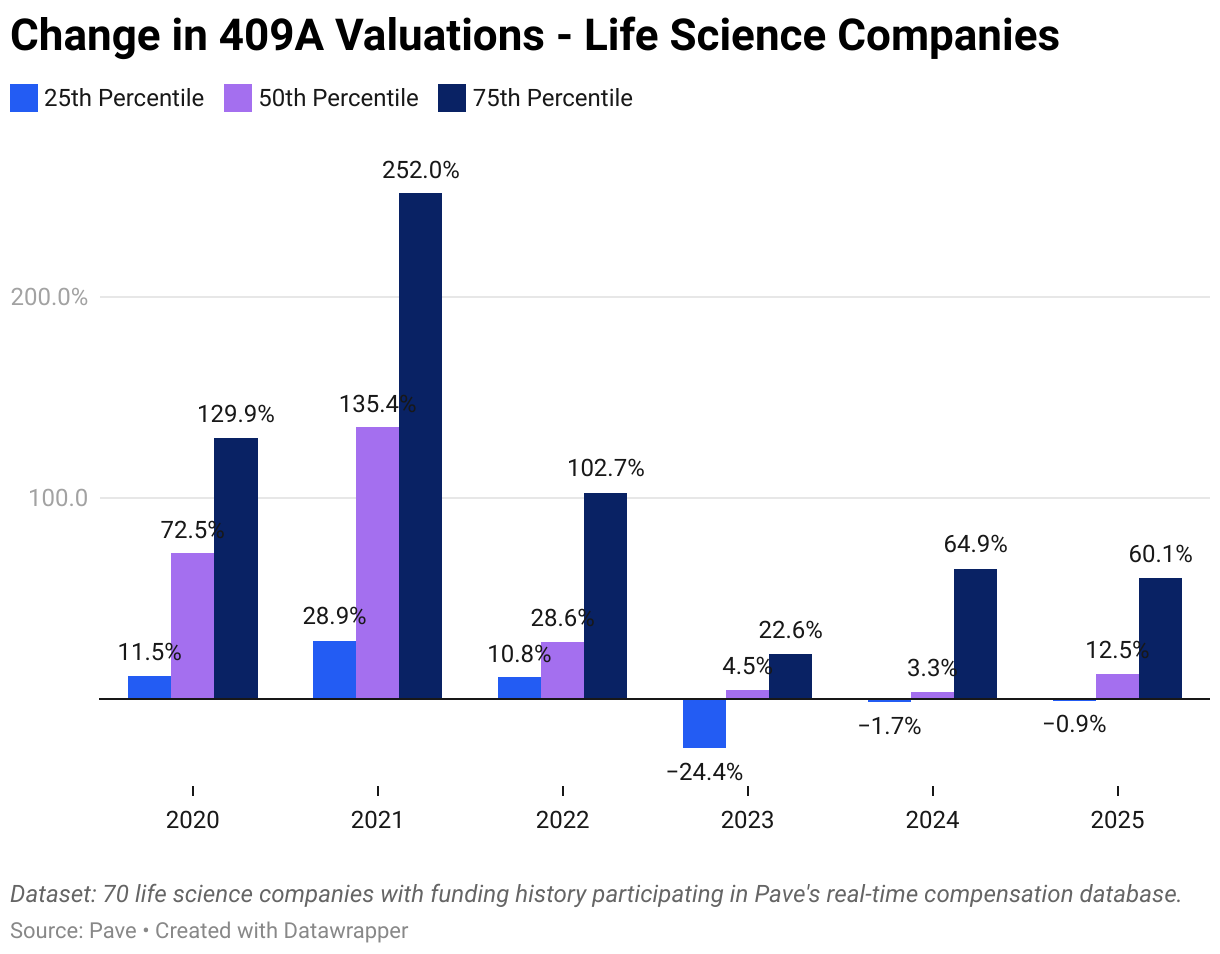
Thanks to Pave’s compensation data, we can see that more than 25% of 409A valuations for private Life Science companies decreased each of the last three years. This helps explain the increase in interest of repricings, particularly in the Life Science industry. The emergence of the Premium Exercise Period makes it easier for more of them to actually happen.
For examples of how companies have used creative equity design to solve retention challenges, see our True Talent Advisory case study and RB Global case study.
Takeaways for Compensation Leaders
The “Premium” Approach is proving to be a valuable tool for leaders navigating the challenges of underwater stock options. It minimizes employee downside, adds retention value, and simplifies execution compared to traditional repricings.
For organizations that want to keep equity meaningful, this creative strategy is worth serious consideration. As argued in our publication, Making a Case for Broad-Based Ownership, equity programs are one of the strongest ways to align employees with long-term success.
To learn more about innovative equity strategies and see the latest repricing benchmarks, visit the Infinite Equity profile in the Pave Partner Directory.
_
This article was written by Ryan Ross, with oversight by Jon Burg.

Ryan is a Managing Director at Infinite Equity, where he helps companies design, value, account for, and track their equity programs. Ryan specializes in the valuation of complex awards requiring Monte Carlo simulation and assisting companies to navigate stock-based compensation accounting. Ryan most recently worked in an equity compensation consulting role from 2014 to 2023, where he served as an Associate Partner and the Western US Practice Leader. Ryan frequently speaks on a wide variety of equity compensation topics across the US. He earned a Bachelor of Science in Economics with a specialization in Financial Markets from Washington State University and is a Certified Equity Professional and a Fellow of Global Equity. Ryan is based in Midland, Texas.