
Anxiety over artificial intelligence (AI) displacing workers has dominated headlines for the better part of three years. Some of these concerns are certainly well-founded. But a parallel story—one receiving far less attention—is becoming visible in compensation and hiring data: AI is generating entirely new categories of work, and many of them pay exceptionally well.
A new analysis from Pave, a compensation intelligence platform that aggregates real-time compensation and workforce data from more than 8,700 companies, identifies five emerging roles that are gaining meaningful traction in the labor market. The data illuminates not only how fast these positions are proliferating, but how the market is pricing them relative to established benchmarks.
Job 1: The AI Engineer
The rise of the AI Engineer may be the most anticipated development in the modern labor market—and data from Pave confirms it is real. In January 2023, just 2.7% of companies in Pave's dataset employed at least one AI Engineer. By January 2026, that figure had reached 8.4%.
To understand the role, it helps to situate it on a spectrum. First, Software Engineers design and maintain the software systems and applications that power modern technology. Next, AI Engineers specialize in integrating AI into those systems—deploying existing AI models to build intelligent, production-ready features and products. And finally, AI Research Scientists occupy the far end of the spectrum, developing novel models from scratch to advance the boundaries of what AI can do.
When it comes to compensation, Pave data reveals something significant: median base salaries in the United States at equivalent job levels for AI Engineers and Software Engineers are relatively close to each other. If that near parity holds, it suggests the two roles are converging. This means the ability to integrate AI into software is rapidly becoming a baseline expectation for anyone writing code, rather than a highly specialized premium skill. Indeed, most companies are reluctant to create net-new AI Engineering job families as they simply expect the Software Engineer to evolve.
The compensation gap widens considerably when comparing AI Engineers to AI Research Scientists. AI Engineers currently earn a median base salary -19.9% lower than their research-focused counterparts—a differential that reflects the distinction between applying AI and inventing it.

Job 2: The Go-to-Market Engineer
Few roles illustrate the velocity of AI's influence on business operations quite like the Go-to-Market (GTM) Engineer. Popularized in part by Clay, a data enrichment and outreach platform, the GTM Engineer sits at the intersection of sales, marketing, and software and is responsible for building and operating the AI-powered systems that drive revenue growth.
The numbers are striking. The share of companies in Pave's database with at least one GTM Engineer grew from under 0.1% in January 2023 to 1.3% in January 2026, with the sharpest acceleration occurring in early 2025. The absolute prevalence of this job remains modest, but the rate of change is a leading indicator of demand.
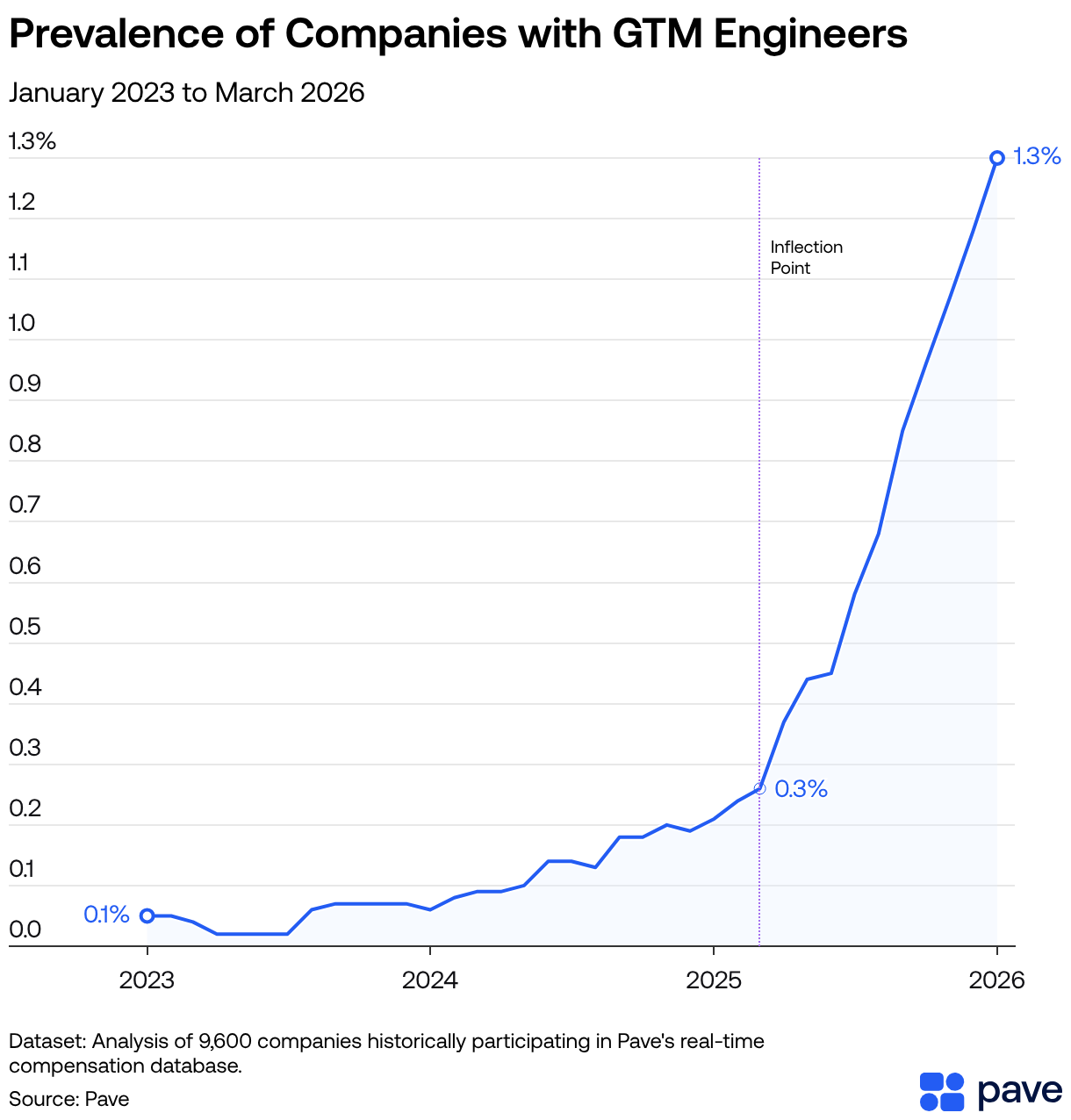
Compensation data from Pave reinforces this role's technical foundation. When comparing median base salaries in the United States at equivalent job levels, GTM Engineers earn 24.7% more than traditional Revenue Operations professionals—a premium that reflects the engineering rigor the position demands.
At the same time, GTM Engineers earn 6.4% less than Software Engineers on a level-normalized basis, a relatively small gap that still positions the role squarely within the realm of engineering pay rather than sales and revenue operations pay. In sum, the market is treating this as an engineering job with commercial fluency, not the reverse.

Job 3: The Forward Deployed Engineer
The Forward Deployed Engineer (FDE) is not an entirely new concept—Palantir built much of its early enterprise business on the FDE model—but AI has given this job new urgency and scale. Companies including Anduril and Scale AI have helped popularize the role further as their enterprise clients seek deeply embedded technical support to implement and customize complex AI systems.
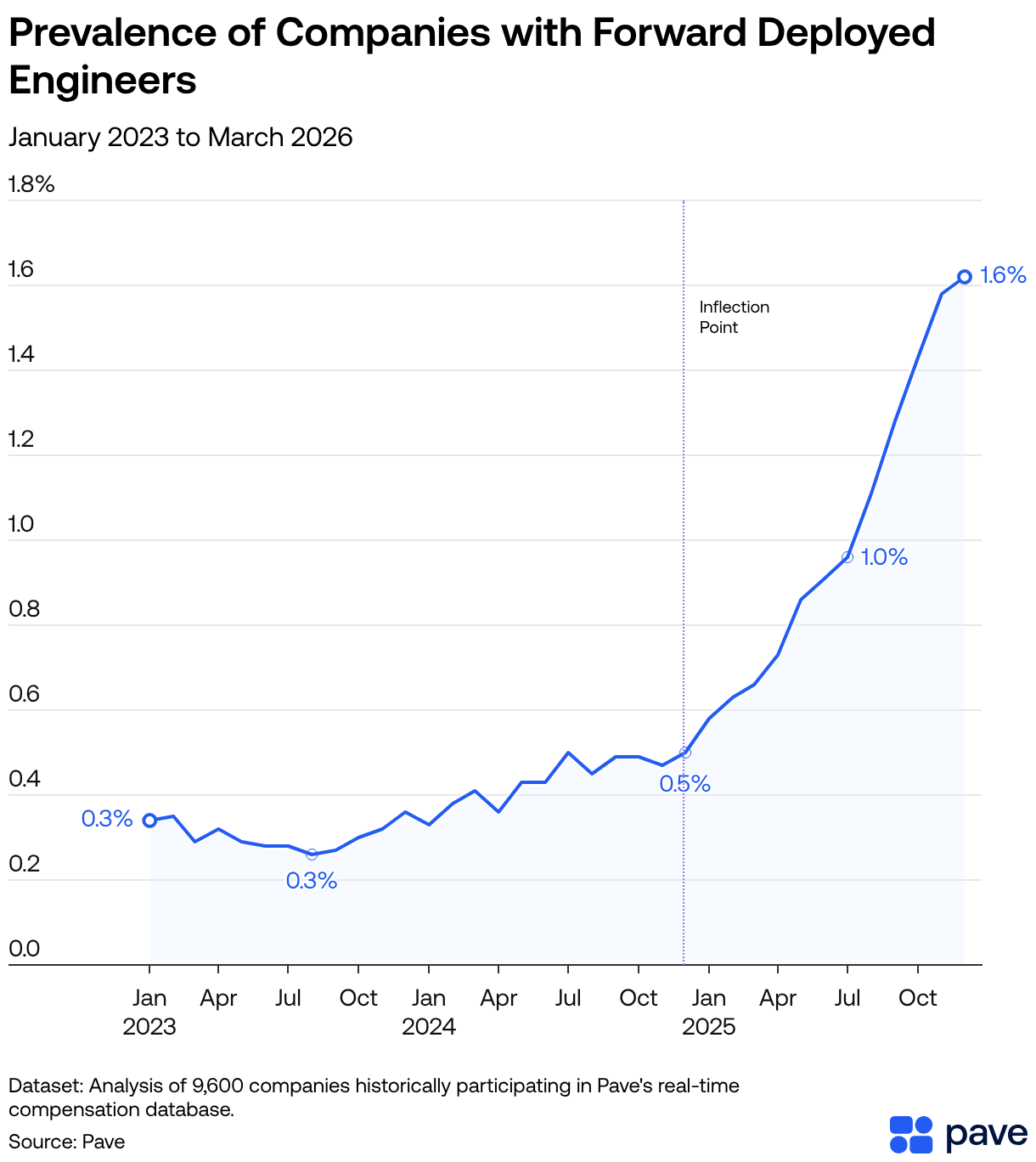
The prevalence of Forward Deployed Engineers in Pave's dataset grew from 0.3% of companies in January 2023 to 1.6% in January 2026, with a notable inflection point in early 2025 that mirrors the GTM Engineer trend.
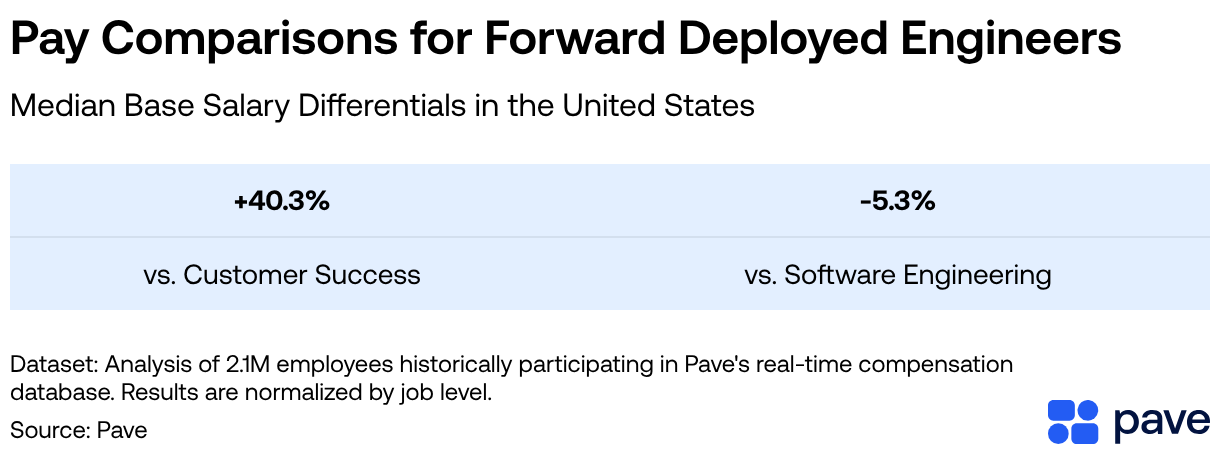
Once again, compensation data from Pave makes a pointed statement about how employers value this work. When comparing median base salaries in the United States at equivalent job levels, Forward Deployed Engineers earn 40.3% more than professionals in traditional Customer Success and Implementation roles—the largest differential of any role examined in this analysis.
Forward Deployed Engineers earn just 5.3% less than Software Engineers on a level-normalized basis, placing them inside most existing engineering pay bands. The message from the market is clear: this is a technical role first and a customer-facing one second.
Job 4: The AI Transformation Lead
The launch of ChatGPT in late 2022 triggered a wave of organizational curiosity about AI. Translating that curiosity into durable strategies requires dedicated leadership, and that is precisely the gap the AI Transformation Lead was created to fill. These professionals identify where AI can generate the most value within an organization and lead the change management efforts required to realize it.
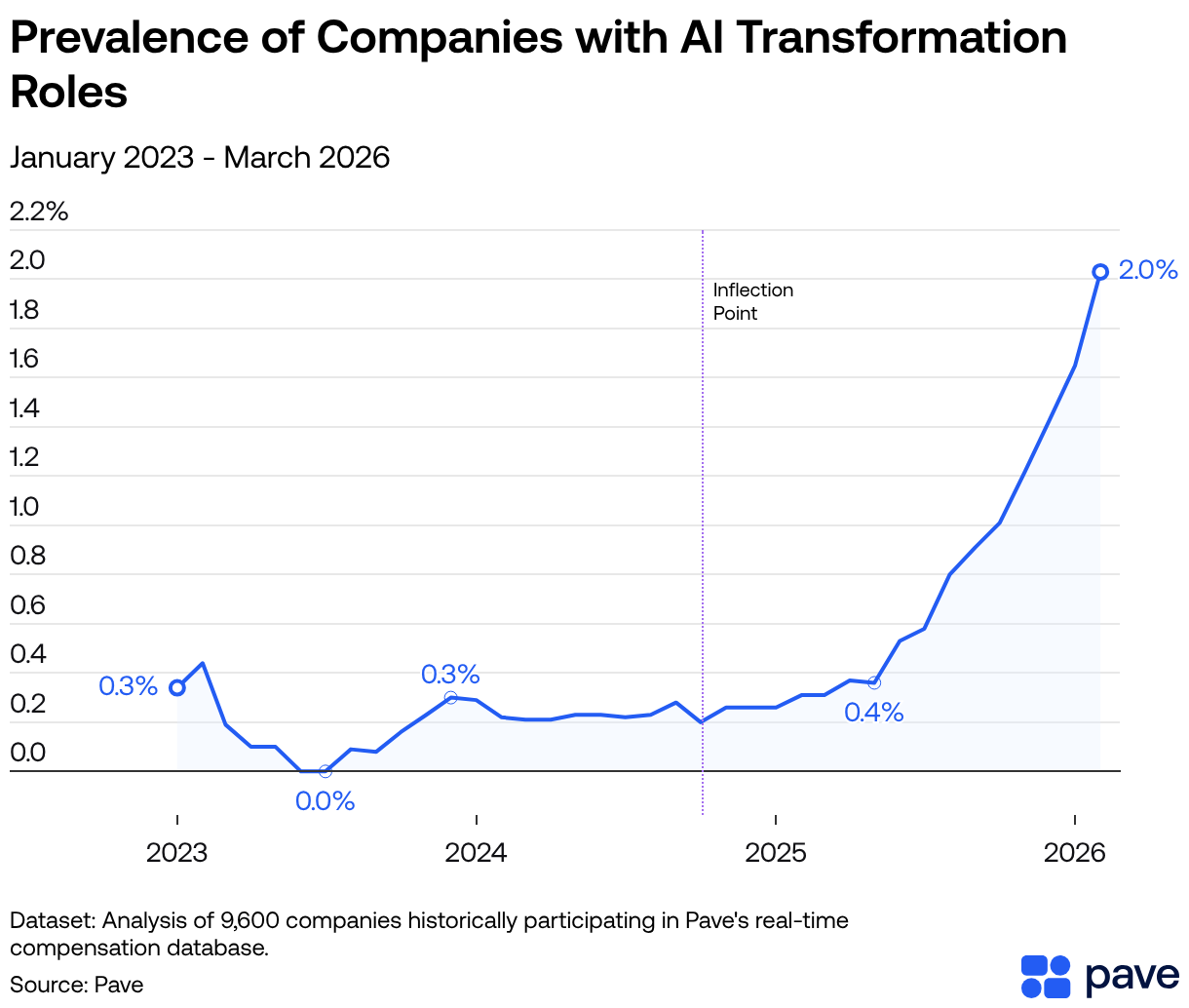
The role first surfaced in early 2023 before plateauing as initial AI enthusiasm gave way to more measured adoption efforts. Things changed in mid-2025, when hiring accelerated sharply. By January 2026, more than 2.0% of companies in Pave's dataset had at least one AI Transformation Lead on staff, up from 0.2% three years earlier. Companies that were experimenting with AI in 2023 are now building the internal teams and infrastructure to scale it—and they need dedicated leaders to manage the transition.
Compensation premiums are pronounced for this role. When Pave compared median base salaries in the United States at equivalent job levels, AI Transformation Leads earn 30.2% more than Strategic Business Operations professionals and 15.3% more than Human Resources Business Partners. Those premiums reflect genuine scarcity: the combination of technical fluency, strategic vision, and organizational change management experience this role demands is rare in the labor market.
Job 5: The AEO/GEO Specialist
As large language models reshape how people discover information online—through tools like ChatGPT, Claude, and Google's AI Overviews—a new discipline is emerging in response. Answer Engine Optimization (AEO) and Generative Engine Optimization (GEO) Specialists focus on ensuring that companies surface meaningfully in AI-generated responses, extending and in some cases supplanting the traditional practice of search engine optimization (SEO).
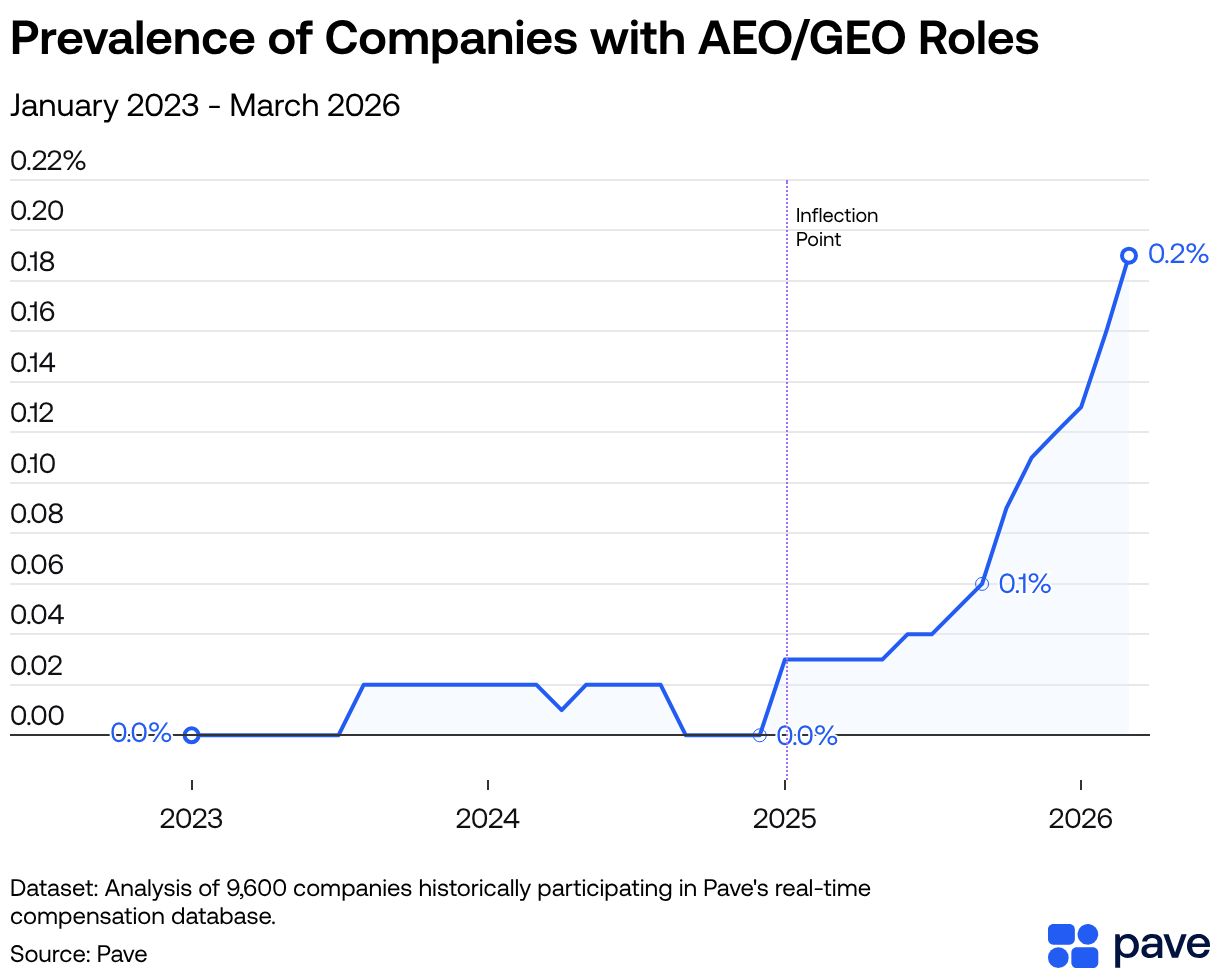
According to Pave data, the role was virtually nonexistent before 2025, but hiring accelerated sharply in the latter half of that year and has continued into 2026. Although, to be fair, fewer than 0.2% of companies have one or more AEO/GEO Specialists. For professionals with backgrounds in SEO, content strategy, or digital marketing roles, this emerging, but still nascent job represents one of the clearest opportunities to build expertise ahead of mainstream demand.
On the compensation front, Pave data shows AEO/GEO Specialists currently earn slightly less than both Digital Marketing (–6.0%) and Social Media (–5.4%) professionals when comparing median base salaries in the United States at equivalent job levels. This is consistent with the pattern for very early stage roles: compensation typically lags behind demand early in a role's lifecycle, then accelerates as the talent supply fails to keep pace.
Given the trajectory of hiring already evident in the data, this gap is likely to close quickly over the course of 2026. The case for early movers is less about immediate pay than about building rare, defensible expertise before the market prices it in.
What the Data Signals
The jobs emerging in the AI era are not afterthoughts or stopgap measures. Roles such as the Forward Deployed Engineer and the AI Transformation Lead command significant compensation premiums over their closest peers—differentials that reflect genuine scarcity of skill rather than market enthusiasm alone.
Even roles at an earlier stage of the compensation curve, like the AEO/GEO Specialist, offer something arguably more valuable to early movers: the opportunity to become expert in a discipline before the market fully recognizes its worth.
For business leaders, the implications are equally direct. These roles exist because implementing AI at scale is harder, more strategic, and more relationship-intensive than the technology alone can manage. Organizations investing in this emerging talent layer are building a structural advantage. The question in 2026 is not whether these roles will matter—it is whether a given organization will be positioned ahead of the curve, or working to catch up.

Alex is the General Manager for Pave's Market Data product and the firm's Vice President of Strategy. He has more than two decades of experience in total rewards, including 10 years working at Aon plc developing and growing the Radford Survey platform.